The Best Ecommerce Fulfillment Companies in Germany (2026): Full Comparison
Scale your operations in Germany. This guide breaks down the five strongest 3PL partners for DACH and European brands, comparing Hive, Bigblue, everstox, byrd, and Zenfulfillment across network coverage, platform integrations, costs, and compliance support. Every insight is verified against 2026 operational data and the latest EU customs regulations.
.png)
Key Takeaways
- Germany is the largest ecommerce market in the European Union, and a domestic warehouse puts standard DHL Paket delivery at 1 to 2 business days for German customers.
- The five providers most brands shortlist for German fulfillment are Hive, Bigblue, everstox, byrd, and Zenfulfillment. Hive and Zenfulfillment are Berlin-based, while everstox and byrd route orders through partner warehouses instead of running their own operations.
- German 3PL pricing typically falls between EUR 2.50 and EUR 6.50 per order for pick, pack, and shipping, with pallet storage at EUR 15 to EUR 30 per month. No major provider publishes fixed rates.
- Since July 1, 2026, the EU charges a EUR 3 flat customs duty per item type on low-value parcels imported from outside the EU. Fulfilling from inventory already inside Germany avoids that per-parcel cost entirely.
- Shop platform coverage separates providers in Germany. The local stack includes Shopware and Xentral alongside Shopify and WooCommerce, and not every 3PL supports all of them natively.
Why Germany Is Europe's Fulfillment Hub
German shoppers do not forgive slow delivery. They order from the EU's largest ecommerce market, they are used to DHL Paket arriving within 1 to 2 business days, and they abandon checkouts when the delivery promise looks vague. If your inventory sits in France, Poland, or a UK warehouse, you are competing against that expectation with a handicap.
Geography does the rest. A warehouse in Germany reaches the entire DACH region domestically or near-domestically, and sits within short trucking distance of the Netherlands, Belgium, France, Austria, and Poland. That is why so many brands treat Germany as the anchor of their European operations: serve your biggest EU market at domestic speed, then extend outward. Our ecommerce fulfillment guide covers the mechanics in detail.
There is a second reason Germany rewards local operations: the regulatory layer. Packaging registration under the VerpackG (the LUCID register), returns-heavy buying behavior, and, since July 2026, a new EU customs duty on low-value imports all favor brands that hold stock inside the country and work with a partner who deals with German rules every day. Marketplaces amplify the effect. Amazon.de, Otto, and Zalando all reward fast, reliable domestic fulfillment, something we break down in our guide to the best online marketplaces in Germany.
How Should You Evaluate a German Fulfillment Partner?
Most comparison pages rank providers on four criteria: the accuracy of the delivery promise at checkout, the cost of handling returns, shop platform compatibility, and EU reach. Those four are right. In Germany they are not enough, so we add a fifth: compliance support. Here is what each one means in practice.
- Delivery promise. What cutoff time does the provider offer for same-day dispatch, which carriers do they ship with, and can they back a 1 to 2 day promise at checkout for German addresses?
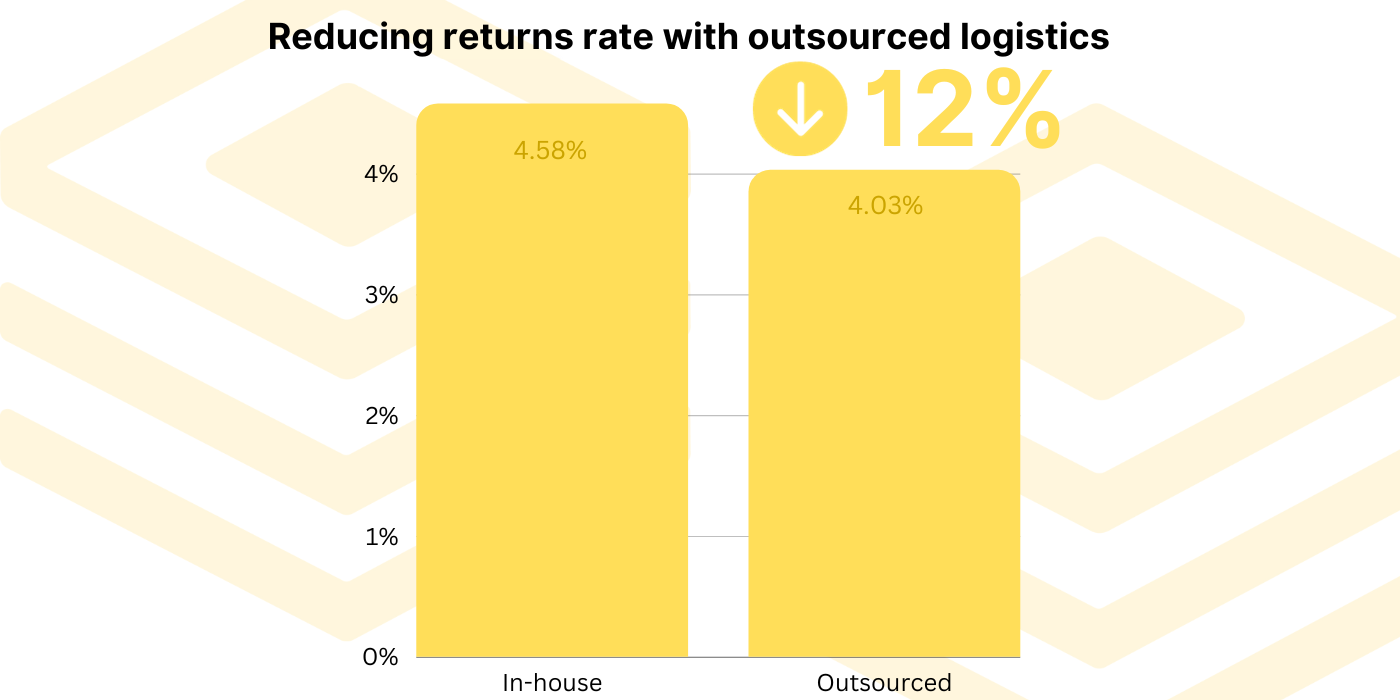
- Returns cost and speed. German return rates are among the highest in Europe, especially in fashion. Ask how fast returned items get back to sellable stock and what each return costs you. Working with the right partner can move this number materially; see our analysis on reducing returns by working with a 3PL.
- Platform integrations. In Germany the relevant stack is wider than Shopify. Shopware and Xentral are core infrastructure for German brands, and WooCommerce remains widespread. A provider that only speaks Shopify will box you in.
- EU reach. Germany first rarely means Germany only. Check whether the provider can extend you into France, Southern Europe, and the Nordics from the same integration.
- Compliance support. LUCID registration, customs handling for non-EU imports, and documentation for the EU's 2026 customs changes. This is where providers without deep German roots struggle.
If you are still mapping what a third-party logistics partner actually takes over, start with our explainer on what 3PL means for ecommerce, then come back to the comparison.
German Fulfillment Providers Compared (2026)
.png)
The 5 Best Ecommerce Fulfillment Companies in Germany
1. Hive: the Germany-anchored operations platform
Hive was founded in Berlin in 2020 and has grown into an end-to-end operations platform rather than a warehouse with software attached. Fulfillment sits at the center, and around it Hive runs freight forwarding into Europe, packaging sourcing, returns processing, and inventory management from a single dashboard. For a brand scaling in Germany, that matters: the partner who stores your stock also books your inbound freight and handles the return that comes back three days later.
The network is built Germany-out. With two flagship proprietary fulfillment centers in the Berlin/Brandenburg metropolitan region (BER2 and BER3 in Rangsdorf) and an interconnected border hub in Słubice, Hive offers unparalleled operational depth in the DACH region. Its network reaches 95% of Europe in 1 to 2 days with an exceptional 99.6% pick-and-pack accuracy rate.
Integrations cover Shopify, WooCommerce, Xentral, and Amazon natively, with an open API and Workato connectors to bridge ERP systems like Shopware. For proof of scale, German brands like Inkster used Hive to grow from 30 to 1,500 daily shipments overnight, while brands like Vetevo rely on Hive's precise reverse logistics to radically reduce return complaints.
Hive Pricing Anchor: By leveraging Hive’s smart Domestic Mix carrier routing, merchants save up to 36% on standard shipping rates. For example, a standard 500g parcel shipped from Hive’s Berlin hub to a domestic customer typically costs between EUR 3.20 and EUR 4.20 all-in (pick, pack, and shipping), depending on volume.
Hive is a strong fit for DTC brands in beauty, supplements, food, and lifestyle that want operational depth, and it holds its own against international names, as our Shopify 3PL fulfillment comparison shows in detail.
2. Bigblue: strong software, thin German footprint
Bigblue is a Paris-based fulfillment company with an in-house software stack that its customers rate highly, around ten fulfillment centers across Europe, and membership in the Shopify fulfillment network. For brands anchored in France or Southern Europe, it is a credible partner.
The catch for a Germany-first brand is coverage. Bigblue's German presence runs through a single site in Dormagen, and its perspective on the German market is that of a French company serving Germany as an expansion zone. If Germany is your primary market rather than your third, the operating depth sits elsewhere.
3. everstox: the orchestration layer for complex setups
Munich-based everstox takes a different approach: it does not run warehouses. Instead, its platform connects merchants to roughly 30 partner fulfillment centers and more than 15 carriers, with an ERP-led integration model that suits brands running both B2B and B2C flows. If you ship 3,000 or more orders a month across multiple channels and countries, the orchestration model is worth a look.
The trade-off is inherent to the model. Your orders are picked by whichever partner warehouse you are matched with, so execution quality depends on that partner, and switching feels less like tuning one operation than re-brokering a relationship.
4. byrd: asset-light network across seven countries
byrd, headquartered in Vienna, operates a partner warehouse network spanning seven European countries, with German capacity provided through regional logistics partners. The pitch is flexibility: distribute stock across the network and promise 1 to 2 day delivery inside Germany with late carrier cutoffs. For mid-size brands below roughly 10,000 monthly orders, it works well.
As with everstox, the asset-light model means byrd's control over the warehouse floor is contractual rather than operational. Brands with demanding requirements around packaging, kitting, or lot tracking should test those workflows before committing.
5. Zenfulfillment: the domestic specialist
Zenfulfillment is Berlin-based and deliberately narrow: Germany only, through two fulfillment centers operated with FIEGE, one of Germany's established logistics groups. For a brand shipping under about 5,000 monthly orders entirely inside Germany, with no near-term cross-border plan, that focus is a feature.
It becomes a constraint the day you want to sell into Austria, France, or the Netherlands from local stock. At that point you are adding a second provider and a second integration, which is exactly the complexity most brands outsource fulfillment to avoid.
What Does Ecommerce Fulfillment Cost in Germany?
None of the five providers above publishes a rate card, so any comparison page quoting exact prices for them is guessing. What can be stated reliably are the market ranges German 3PLs operate within, based on published industry benchmarks for 2026.
- Pick and pack: EUR 0.50 to EUR 2.50 per item, usually with a base handling fee per order on top.
- Complete fulfillment (pick, pack, and ship): EUR 2.50 to EUR 6.50 per order, before packaging extras.
- Storage: EUR 15 to EUR 30 per pallet per month.
- All-in single-item order including domestic shipping: roughly EUR 4 to EUR 9, depending on provider, volume, and carrier contract.
Two pricing dynamics are worth planning for in 2026. Carrier costs are rising, with DHL eCommerce prices up an average of 5.9 percent in January 2026, and those increases flow through 3PL invoices. And volume changes everything: most German 3PLs become economical somewhere between 300 and 500 orders per month, below which in-house fulfillment usually still wins on cost.
How the EU's July 2026 Customs Changes Affect Your Fulfillment Choice
On July 1, 2026, the EU abolished the customs duty exemption for imported parcels worth up to EUR 150 and replaced it with a flat EUR 3 duty per item type on low-value goods entering from outside the EU. The measure, agreed by the Council in December 2025 and given final approval in February 2026, runs until July 2028, when normal customs tariffs take over through the EU's new customs data hub. It applies to sellers registered in the Import One-Stop Shop, which covers around 93 percent of ecommerce imports.
More is coming. Mandatory product identifiers arrive on November 1, 2026, so customs can screen non-compliant goods, and the Commission has proposed an additional EUR 2 handling fee per parcel that could apply from November 2026. The direction is unambiguous: shipping individual parcels into the EU from outside is getting more expensive and more bureaucratic with every regulatory step.
For fulfillment strategy, the conclusion writes itself. A brand that bulk-imports inventory into a German warehouse clears customs once, on one consolidated shipment, and every consumer order after that moves as a domestic parcel with no per-item duty, no product identifier friction at the parcel level, and no surprise charges at the customer's door. Brands selling across borders should also weigh where returns land and how stock rebalances between EU warehouses, which we cover in our guide to cross-border ecommerce fulfillment. Alongside customs, Germany's own rules still apply: any brand selling packaged goods to German consumers must register in the LUCID packaging register under the VerpackG before selling a single unit.
Frequently Asked Questions
What is the best ecommerce fulfillment company in Germany?
For most DTC brands, the best fulfillment company in Germany is one that runs its own German operations and covers the local shop stack, and Hive is the strongest fit on both counts. The right answer still depends on your profile. everstox suits ERP-heavy setups with B2B flows, byrd suits brands that want an asset-light multi-country network, Zenfulfillment suits domestic-only volumes, and Bigblue suits brands anchored in France.
How much does ecommerce fulfillment cost in Germany?
Complete fulfillment in Germany typically costs EUR 2.50 to EUR 6.50 per order for pick, pack, and shipping, with an all-in single-item order landing between EUR 4 and EUR 9 including domestic delivery. Storage adds EUR 15 to EUR 30 per pallet per month. Every major provider prices individually based on volume, product profile, and packaging requirements.
How fast is ecommerce delivery within Germany?
Standard DHL Paket delivers within Germany in 1 to 2 business days, and same-day options exist in cities like Berlin, Hamburg, and Munich. The delivery promise your customers see depends less on the carrier than on your 3PL's cutoff times. A late cutoff with next-day carrier handover is what makes a 1 to 2 day checkout promise honest.
Do I need a warehouse in Germany to sell to German customers?
You do not strictly need one, but fulfilling German orders from a German warehouse is the only reliable way to offer 1 to 2 day delivery and avoid the EU's new per-parcel import duties. Shipping from outside the EU now triggers the EUR 3 low-value duty per item type, and shipping from other EU countries adds one to three days of transit. Both cost you conversions at checkout.
What is the EU's EUR 3 customs duty and does it affect my brand?
Since July 1, 2026, the EU charges a flat EUR 3 customs duty per item type on low-value parcels imported from outside the EU, replacing the old EUR 150 duty exemption. It affects any brand shipping consumer parcels into the EU from non-EU warehouses. Brands that hold inventory inside the EU and fulfill domestically are not affected at the parcel level, since duty is settled once at bulk import.
What is LUCID and do I need to register?
LUCID is Germany's public packaging register, and every brand selling packaged products to German consumers must register in it under the Packaging Act (VerpackG) before selling. Registration is free but mandatory, and marketplaces are required to block sellers without a valid LUCID number. A fulfillment partner with German operations will walk you through it as part of onboarding.
Which shop systems do German fulfillment providers integrate with?
Shopify and WooCommerce are covered by every major provider, but the German stack also includes Shopware and Xentral, and coverage there separates Germany-native providers from international ones. If you run Shopware or plan to adopt Xentral as your ERP, confirm native integration before signing. Middleware workarounds add sync delays exactly where order data needs to be fastest.
At what order volume does outsourcing fulfillment make sense?
Outsourcing to a German 3PL typically becomes economical at around 300 to 500 orders per month. Below that, the fixed platform and minimum fees usually outweigh the savings. Above it, the comparison flips fast, because a 3PL's carrier rates, packed into per-order pricing, beat what a small brand can negotiate alone.
The Bottom Line
Germany rewards brands that treat it as a home market. The buyers expect 1 to 2 day delivery, the regulators expect LUCID registration and clean customs handling, and since July 2026 the EU actively penalizes parcel-by-parcel imports from outside the bloc. Every one of those pressures points toward holding inventory in Germany with a partner that operates there natively.
Among the five providers brands shortlist most often, the structural differences matter more than the marketing. everstox and byrd broker partner warehouses. Bigblue serves Germany from one site and a French headquarters. Zenfulfillment stops at the German border. Hive runs its own Germany-anchored operations with the broadest coverage of the German shop stack and a network that extends across Europe when you are ready.
The best fulfillment company in Germany is the one that treats Germany as home ground, not a delivery zone.




.png)



.png)
.png)