Best Shopify Fulfillment Providers for DTC Brands in Europe: A Comprehensive Guide
For a DTC brand on Shopify, picking the right European fulfillment partner is one of the highest-leverage decisions you'll make. Get it right and you ship to most EU households in 1 to 2 days while protecting your margins. Get it wrong and you spend months decoding opaque invoices as customer loyalty erodes. This guide breaks down the six criteria that separate a good 3PL from the right one: warehouse coverage, Shopify integration, SLAs, cost, DTC services, and reporting.
Key Takeaways
- EU e-commerce hit EUR 842 billion in 2024. Brands without local fulfillment infrastructure are competing at a disadvantage.
- The six criteria that matter: warehouse coverage, Shopify integration depth, SLA commitments, cost structure, DTC services, and real-time reporting.
- There is no single rate card for European fulfillment. Cost is driven by pick and pack, storage, shipping, and returns, and it shifts with country, volume, and product size. Always ask for a full cost model before you compare providers.
- Always run a 30 to 90 day pilot with real orders before committing. Track performance independently, not via your provider's benchmarks.
- Brands selling to both the UK and EU need domestic warehouses on both sides. Cross-border post-Brexit adds 1 to 5 working days and additional customs costs.
Choosing the right fulfillment partner in Europe might not feel like the most exciting decision you will make as a DTC brand. But it is probably one of the most consequential. Get it right, and you can ship to most EU households in 1 to 2 days, protect your margins, and spend your energy actually growing the brand. Get it wrong, and you will spend months firefighting late deliveries, decoding opaque invoices, and watching hard-earned customer loyalty quietly erode.
Europe's B2C e-commerce market hit EUR 842 billion in 2024, up 7% year on year, with Southern and Eastern Europe growing even faster at 9% and 18% respectively (European E-Commerce Report 2025). For DTC brands on Shopify, local fulfillment infrastructure is not a nice-to-have. It is a direct lever on conversion rate and whether customers come back.
This guide walks you through a practical framework for evaluating and choosing a European 3PL for your Shopify store, covering the six criteria that separate a good provider from the right one: geographic coverage, Shopify integration depth, SLA commitments, fulfillment costs, DTC-specific services, and real-time reporting. For a broader primer on how e-commerce fulfillment works, we have a dedicated guide.
What is Shopify Fulfillment and How Does It Work in Europe?
At its simplest, Shopify fulfillment is the automated process by which an order placed in your store flows to a warehouse, gets picked, packed, and dispatched to the customer's door without anyone needing to manually push it along. The logistics behind it are more nuanced in Europe than most brands expect.
In Europe, proximity matters more than people expect. Goods stored near major transport hubs do not just arrive faster; they convert better, generate fewer support tickets, and bring customers back for a second order. When people talk about "Shopify Fulfillment Europe," what they really mean is a connected network of warehouse locations, live inventory management, and carrier integrations, all synced to your store from checkout to tracking update via real-time API.
What Criteria Matter Most When Choosing a Fulfillment Provider?
There is no shortage of 3PLs in Europe. The hard part is knowing what to actually measure. The six criteria below cut through the noise and give you something concrete to compare.
Which Fulfillment Provider Has the Best Pan-European Warehouse Coverage?
Warehouse location is where fulfillment performance gets made or broken. Providers with fulfillment centers in core European markets, Germany, France, the Netherlands, Poland, can reach most EU households within 1 to 2 days. Move further out to Romania, Bulgaria, Malta, or Cyprus, and even the best-positioned central hubs add 1 to 2 days on top of that.
Hive runs 9 fulfillment centers that reach 95% of EU households within 1 to 2 days. Beyond speed, warehouse location also shapes your returns economics and carbon footprint. Both are showing up more frequently in brand positioning conversations, and for good reason.
How Does a Fulfillment Provider Integrate With Shopify?
A native Shopify integration means orders, inventory, and tracking data stay in sync in real time. Through the Shopify API, you can automate shipping rule decisions, trigger low-stock alerts automatically, and push tracking updates to customers the moment a parcel leaves the warehouse.
The things worth looking for: real-time order sync and inventory reconciliation, automated shipping rules and tag-based routing, and automatic tracking notifications to customers. These are not bells and whistles. They remove the manual errors that quietly eat into margins and customer trust.
What SLAs Should a Fulfillment Provider Guarantee?
An SLA is only as valuable as the commitments it actually contains. Professional providers should be able to show you documented metrics: pick accuracy of 99.5% or above (best-in-class providers publish figures between 99.6 and 99.95%), same-day or next-day dispatch, and a clear escalation and issue resolution process.
Strong SLAs give you planning certainty as you scale. But do not just read them. Ask for reference customers. Ask for historical performance data. If a provider hesitates on either, that tells you something important before you have signed anything.
What Does Shopify Fulfillment Cost in Europe?
Costs in European 3PL fulfillment break down across four areas, and each one deserves scrutiny.
Pick and pack is the labor of getting an order out the door: someone retrieving each item from its shelf, assembling the order, packing it into the right box or mailer, and adding any inserts or branded touches. Simple single-item orders sit at the lighter end. Multi-line orders, kitting, gift wrapping, or custom inserts all add handling time, and that time is what you are paying for.
Storage is what it costs to keep your stock sitting in the warehouse, usually charged by pallet, shelf, or bin over a given period. The longer a SKU sits, the more it adds up, and most providers apply long-term storage surcharges once inventory passes a certain age. Slow-moving stock is where this quietly eats into margin.
Outbound shipping is the cost of actually delivering the parcel to your customer. It is driven by weight, dimensions, destination, and the carrier mix your provider has negotiated. Domestic parcels are cheaper than cross-border ones, and anything moving between the EU and the UK carries added cost from customs and duties handling.
Returns handling covers receiving the parcel back, inspecting the item, deciding whether it can be resold, and getting it back into sellable stock or routed to disposal. Repackaging, quality checks, and restocking all add to the bill.
A note on pricing: there is no single rate card for European fulfillment, and anyone who hands you one without asking questions first is guessing. What you pay shifts with the country your stock is stored in, since labor, rent, and energy costs vary widely from one market to the next. It shifts with order volume, because higher throughput usually unlocks better per-unit rates. And it shifts with the size and weight of your products, the complexity of each order, and how much custom handling you need. Two brands shipping the same number of orders can still end up with very different bills.
One practical note: always ask for a full cost model that includes receiving fees, returns processing, minimum monthly commitments, and any peak-season surcharges. Hidden fees are the single most common post-onboarding complaint in this category. You will not be the first brand to be caught out by them.
What DTC-Specific Features Should a Fulfillment Provider Offer?
Fulfillment is not just logistics. For a DTC brand, it is part of the product experience. The unboxing moment, the branded insert, the smooth return. These are the things that turn a one-time buyer into a returning customer.
Look for branded packaging and personalized inserts, an automated returns portal built for Shopify, and sustainable shipping options such as carbon-neutral carriers and recyclable packaging. Confirm your provider can actually support your packaging specifications before you start onboarding. Not all of them can, and finding out later is an expensive lesson.
What Technology and Reporting Should a Fulfillment Provider Provide?
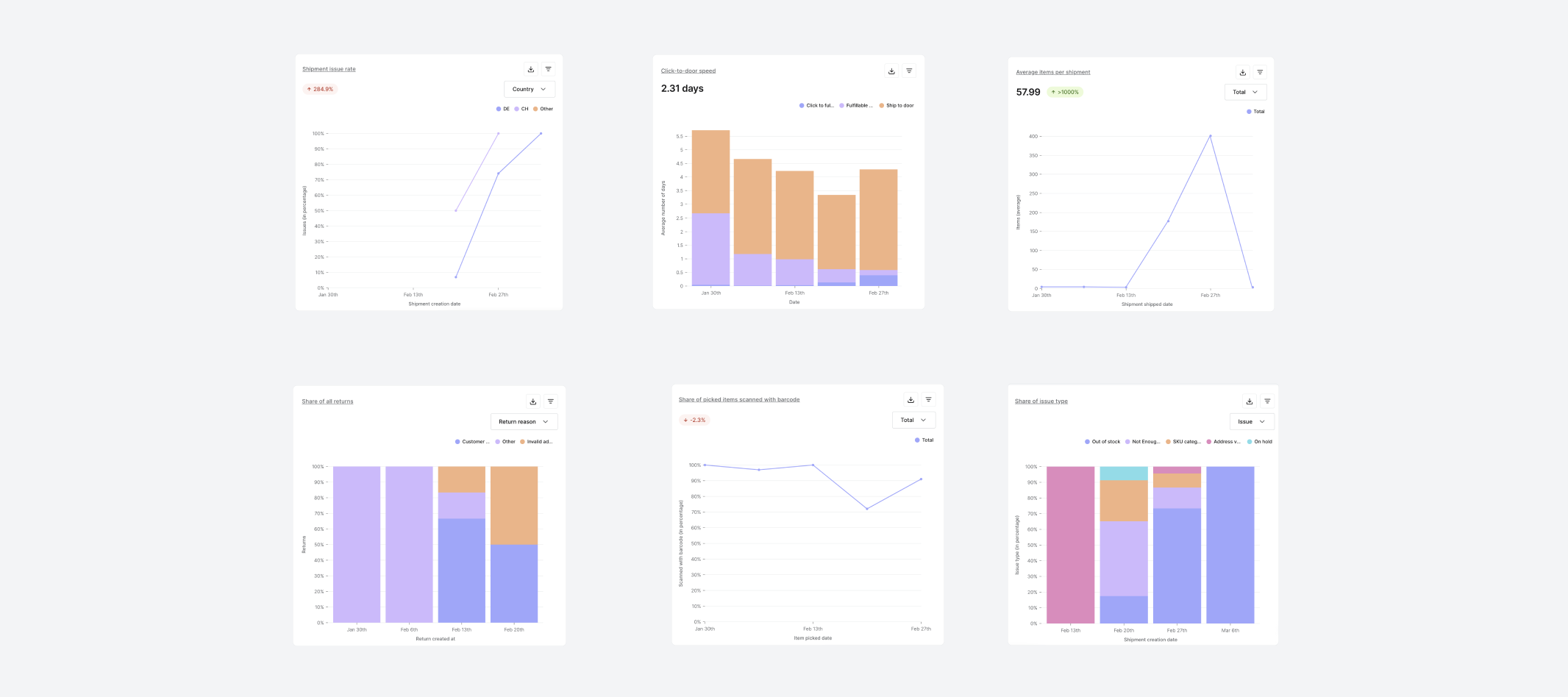
A modern warehouse management system connects your Shopify store, ERP, and BI tools via APIs and gives you live dashboards across inventory levels, demand forecasts, and throughput. That real-time visibility is what lets you catch a stockout before it costs you sales, or spot a returns spike before it turns into a customer service crisis.
When evaluating, push for live order status reporting, API-based ERP integration, and early-warning systems for reorder triggers and performance KPIs. And ask for a live demo of the actual dashboard, not a polished slide deck. There is a meaningful difference between what a Warehouse Management System (WMS) can theoretically show and what the day-to-day reporting experience actually feels like.
Top 5 Fulfillment Providers for Shopify in Europe: Side-by-Side Comparison
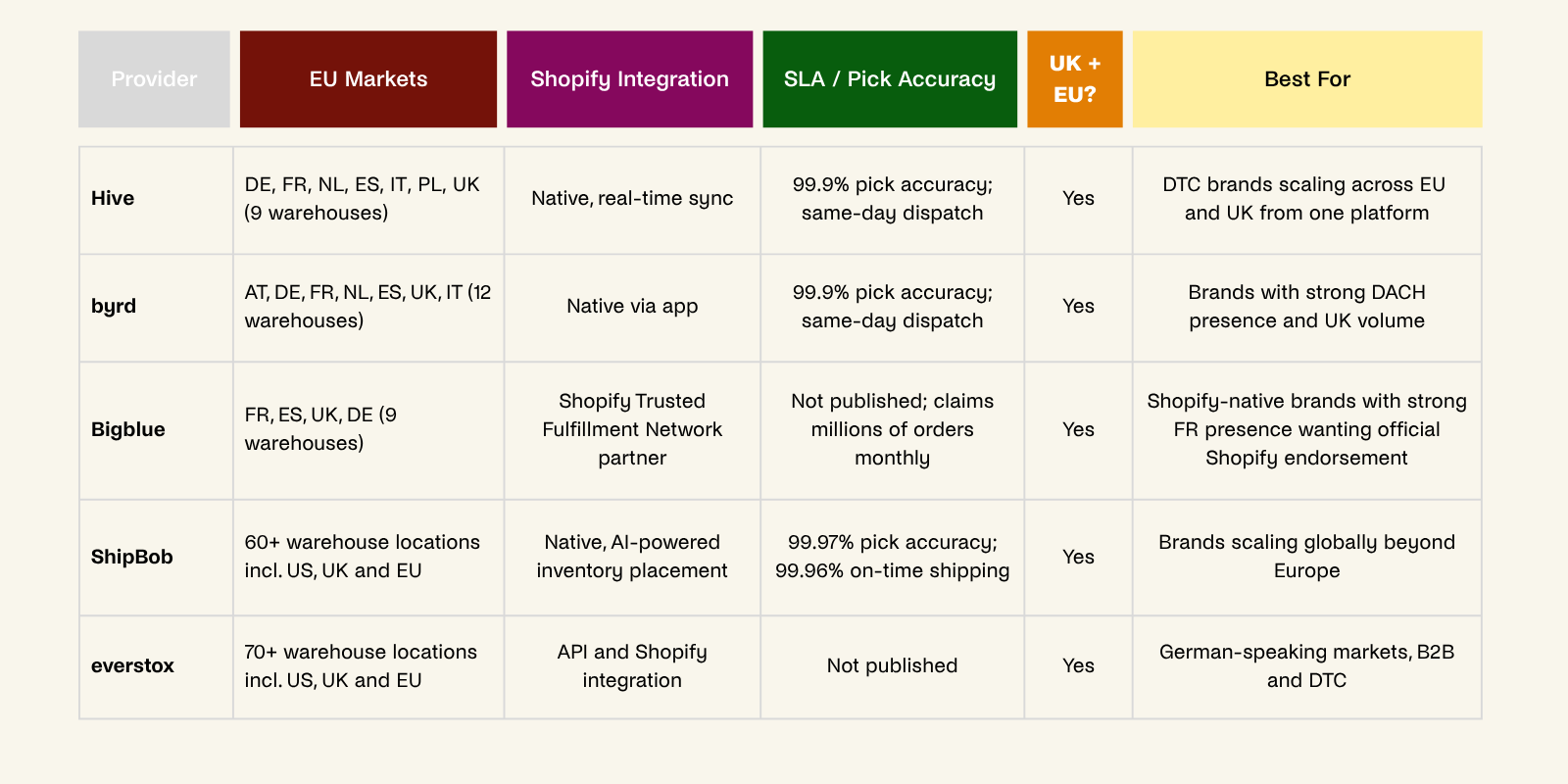
The table below compares the main providers for European DTC brands on Shopify. Coverage and SLA data are based on publicly available information as of May 2026. According to Hive's 2026 network data, 95% of EU households can be reached within 1 to 2 days from its 9 fulfillment centers across Germany, France, the Netherlands, Spain, Italy, Poland, and the UK. For a deeper breakdown, see our full Shopify 3PL Fulfillment Comparison.
How Do You Find the Right Fulfillment Partner, Step by Step?
Step 1: Define Your Goals and KPIs
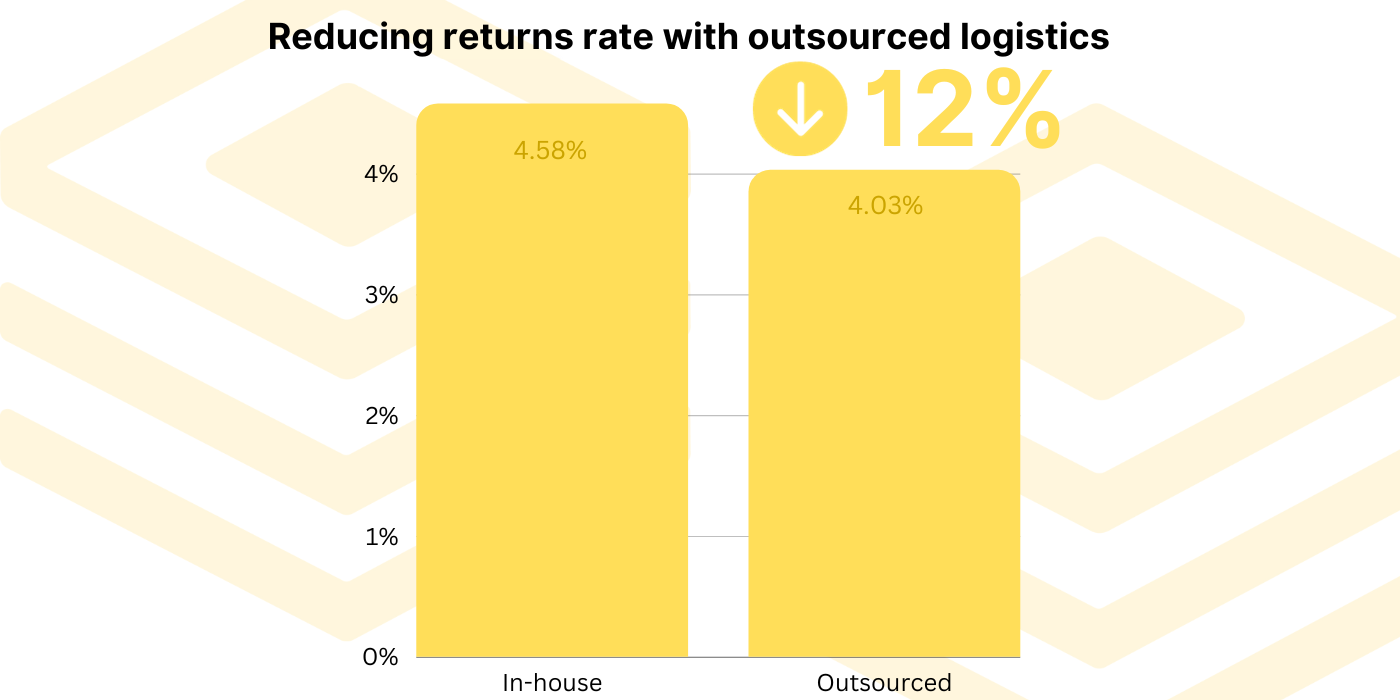
Before you send a single RFP, get clear on what you are actually trying to achieve. A delivery time target of under 48 hours EU-wide is a solid baseline. Pick accuracy above 99% should be non-negotiable. On returns, the DTC average in Europe sits at 14 to 20% by unit volume. Top performers achieve 10 to 12%. Sub-20% is a realistic year-one target; sub-12% is the strong performance benchmark (source: Synctrack / ReturnPrime, 2025).
These KPIs become your negotiating baseline. Without them, every provider pitch will sound equally convincing.
Step 2: Prioritize Your Target Markets in Europe
Pull your order data by country. Where is demand highest? Where are your margins best after shipping costs? Germany, France, the Netherlands, Spain, and the UK account for the bulk of European DTC volume. Eastern European markets are growing fast but often carry lower average order values, so the unit economics look different. For US DTC brands planning their first expansion into Europe, our EU expansion guide is a useful place to start on market prioritization.
Step 3: Build a Shortlist Focused on Coverage and Shopify Integration
Map 3 to 5 providers against your top markets. Check country coverage, Shopify integration depth, and DTC-specific features such as branded packaging, a returns portal, and sustainability options. Drop any provider with limited integration or unclear service levels early. The comparison table above and our Shopify 3PL Fulfillment Comparison are useful starting points.
Step 4: Run an RFP and a Pilot Phase
Your Request for Proposal should nail down cost models, SLA commitments, and integration requirements in writing. Then run a 30 to 90 day pilot with real orders. Track shipping times and error rates independently. Do not rely on the provider's own benchmarks. If they are not comfortable with you tracking performance independently, that is information too. Our guide on how to scale e-commerce fulfillment covers what to look for once you are live and growing.
Step 5: Lock In SLA Monitoring and Escalation Processes in the Contract
Measurable metrics need to be in the contract: dispatch time, error rates, returns processing timelines. Agree on regular performance reviews and documented escalation paths. A vague SLA with no enforcement mechanism is not a protection. It is a source of future frustration.
Step 6: Onboard Carefully and Optimize Continuously
Prepare for data migration, API testing, and peak season scenarios before go-live. After launch, build in regular feedback loops and analytics reviews. Make sure you know who is responsible for each milestone before you sign. The onboarding phase is when most issues surface. A clear project plan is worth far more than a friendly conversation.
What Practical Tips Make a Fulfillment Partnership Work?
Test Before You Commit
Start with a test order batch before you move your full fulfillment volume. Measure lead times, shipping speed, and accuracy independently. Track error rates and SLA deviations throughout. Switching providers after full integration is painful and expensive. Switching before it is much less so.
Get Returns Right From the Start
A documented returns process with dedicated contacts, a digital portal, and transparent cost structures protects your margins and creates a meaningfully better customer experience. Track your return rates closely. If yours is sitting well above the 14 to 20% DTC category average for Europe, investigate the root causes before attributing it to your 3PL. Size guides, product photography accuracy, and delivery damage rates all play a bigger role than people assume.
Integrate Your Data Stack Before Go-Live
Before onboarding, get clear on which data flows you need via API or ERP. Early integration creates the foundation for automated demand forecasting, seasonal planning, and smarter inventory placement. Brands that connect their analytics stack before launch consistently reduce their cost per order and scale faster.
Frequently Asked Questions
What is Shopify fulfillment and how does it work for DTC brands in Europe?
In short: it automates the flow from checkout to delivery, with no manual intervention required.
Shopify fulfillment connects your store to a fulfillment center via native integration. Orders are transmitted automatically, processed, and shipped to your customer. For a complete breakdown, see our e-commerce fulfillment guide.
What integrations are critical when evaluating Shopify fulfillment providers?
At minimum: native Shopify sync for inventory, orders, and tracking in real time.
Beyond that, look for API access for your ERP or BI tools, automated shipping rules, and a returns management integration. These three layers are what make a 3PL feel like a natural extension of your stack rather than a manual handoff.
When does it make sense to outsource fulfillment to a 3PL?
When same-day dispatch is becoming a strain, carrier management is consuming meaningful team time, or you want to expand across other markets.
As a rule of thumb, outsourcing to a 3PL starts to make economic sense at around 100 orders per month. Above 1,000 orders per month, a specialist partner almost always outperforms in-house operations on cost, accuracy, and delivery speed. Once you are shipping to multiple EU markets and managing your own carriers, a professional 3PL delivers faster throughput, lower per-unit shipping costs through volume rates, and SLA accountability that internal operations rarely match.
How do warehouse locations affect delivery times and shipping costs?
Closer to your key markets means faster delivery and lower per-shipment costs, usually by 1 to 2 days and EUR 1 to 3 per order.
Germany and the Netherlands are the most common EU hub locations, given their central position and carrier density. Poland is increasingly popular as a cost-efficient option for Central and Eastern Europe.
What should good returns management look like from a fulfillment provider?
Digital return portal, inspection and restock within 48 hours, and transparent per-return pricing with no surprises.
The DTC industry average return rate is 14 to 20% by unit volume, which makes returns handling a real cost line. Providers that offer automated restocking rules and grading workflows reduce both the labor cost and the resale value loss from returned goods.
Which Shopify fulfillment provider covers both the UK and the EU?
Hive, byrd, Bigblue, and ShipBob all offer domestic warehouses on both sides. Verify current coverage before signing.
After Brexit, UK-EU cross-border shipping requires customs documentation and can add 1 to 5 working days, with delays stretching to 7 days in cases of documentation errors or inspection by HMRC or Border Force. Providers with confirmed UK and EU coverage include Hive (DE, FR, NL, ES, IT, PL, UK), byrd (AT, DE, FR, NL, ES, UK, IT, SE, DK, PL), Bigblue (FR, ES, UK, DE), and ShipBob (60+ global locations).
How long does onboarding with a fulfillment provider typically take?
Expect 4 to 8 weeks from contract signature to first live order.
The main phases are: API and Shopify integration setup (1 to 2 weeks), stock transfer and receiving at the fulfillment center (1 to 3 weeks), testing with real orders (1 week), and full go-live. Brands switching from an existing 3PL should allow an additional 1 to 2 weeks for stock-in-transit overlap.
What is the difference between a 3PL and a 4PL fulfillment provider?
A 3PL does the physical work. A 4PL manages multiple 3PLs. Most DTC brands need a 3PL.
A 3PL handles warehousing, picking, packing, and shipping. A 4PL coordinates multiple 3PLs and supply chain partners as a management layer. A 4PL becomes relevant once you are operating across more than three regions or working with multiple warehouse partners simultaneously.
The Bottom Line
Most brands that find the right partner describe the same turning point: the moment they stopped treating fulfillment as a line item and started treating it as infrastructure that either builds the brand or quietly undermines it.
The details matter more than they appear to at first. Get the warehouse network right, and delivery speed, conversion rates, and repeat purchase rates all improve together. Get it wrong, and no amount of good marketing compensates for a 4-day delivery and a confusing returns experience.
Before you sign anything, define what good looks like. Run a real pilot. And be honest about whether you need a partner that can hold your UK and EU operations under one roof. For most DTC brands scaling across both markets, that question narrows the field faster than anything else.
.png)






.png)



.png)
.png)