EU €3 Customs Duty 2026: A Complete Guide for UK Brands
A €3 customs duty applies to every low-value consignment (under €150) entering the EU from outside the bloc. This is the EU's removal of the de minimis exemption, also known as Low Value Consignment Relief (LVCR), which has allowed parcels below €150 to clear customs duty-free. The fee covers roughly 93% of e-commerce flows into the EU.

How the EU €3 customs duty work
The €3 is a bloc-wide measure, and sits within a wider EU customs reform that culminates in March 2028 when the €150 exemption disappears entirely. The €3 duty applies per product type. For multi-product orders, the fee stacks: €6 for two product types, €9 for three, and so on.

A separate handling fee per product type is also proposed for no later than 1st November 2026 estimated at around €2, which would bring the combined charge to roughly €5 per product type.
For UK brands shipping D2C into the EU, the cumulative impact lands on: margin, checkout conversion, customer experience and retention.
This guide walks through what's changing, how to calculate the impact on your business, and the 11 actions to take before 1st July to ensure your margins don't see a dip.
What is the impact on your business?
To calculate your exposure on current EU order volume:
1. Split your EU orders by single-item versus multi-product
2. Note the average number of distinct product types per order
3. Multiply €3 by that count for each multi-product order
The bigger your bundle, kit, and gift-set volume, the more meaningful this stacking becomes. Worked examples below.
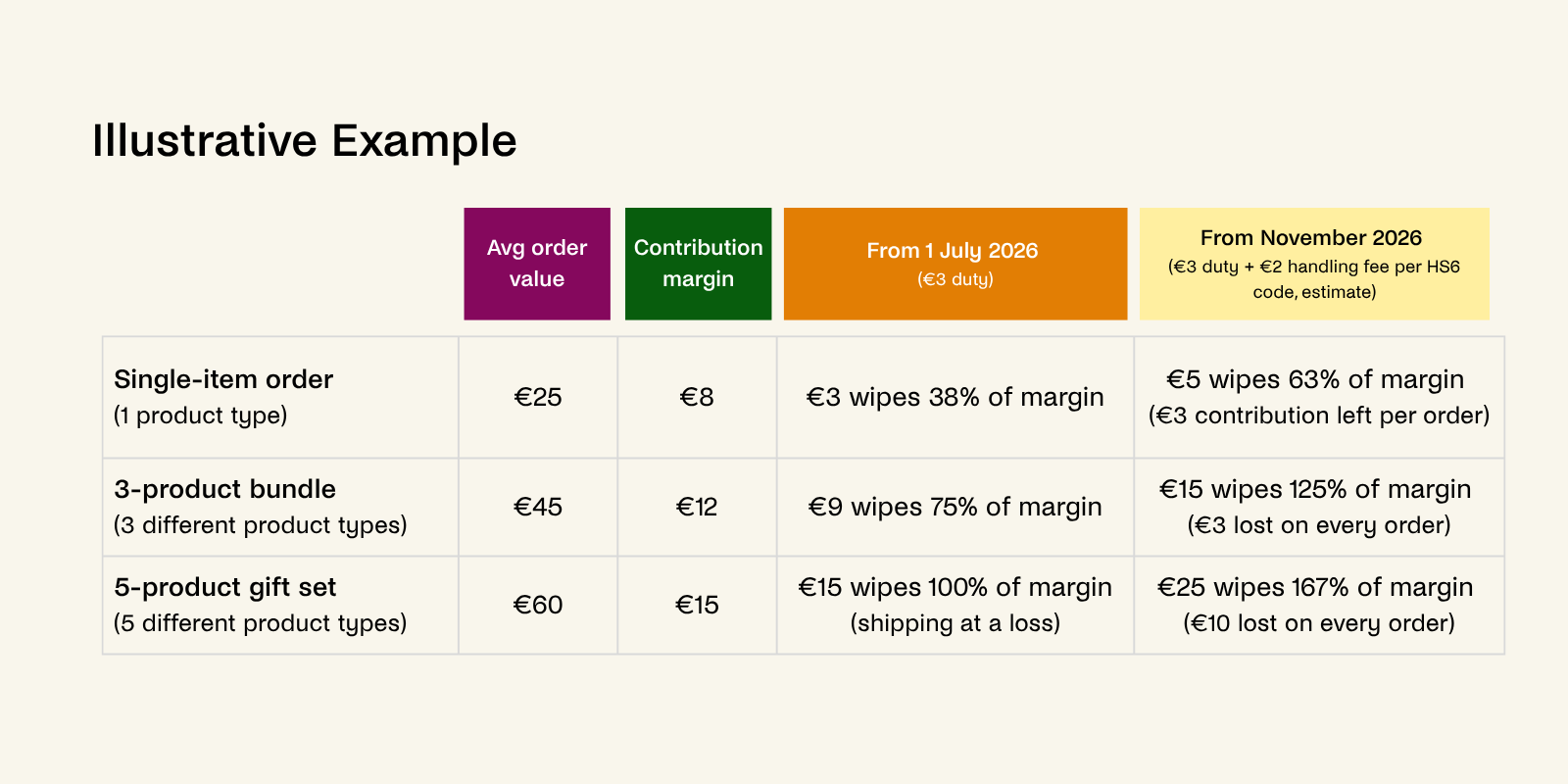
Note: 1) Contribution margin numbers are illustrative, in line with typical D2C margins (25%-32%). Run your own to find your actual exposure. 2) HS6 tariff classification is the six-digit Harmonised System code customs authorities use to identify what's in a parcel.
Apart from your margins compression, you'll also feel it:
- Checkout friction. EU shoppers already scrutinise "final delivered price" and "surprise fees at the door." A vague answer will tank existing conversion. Additionally, your competitors with EU stock will also undercut you on landed price. They don't carry the duty into checkout. You do. The EU customs duty impact will most clearly show up in the conversion gap that widens through the second half of 2026.
- Returns and customer experience cost. Landed-cost surprises mean more refused deliveries, more support tickets, more refund requests. More expensive to resolve, slower to recover.
- Repeat purchase rates drop. EU customers who got hit with surprise fees, delays, or refused parcels remember the experience. They don't come back. For D2C brands where lifetime value carries the unit economics, this is the slow-burn cost. Quieter than the margin compression in month one, harder to recover from over six months.
Which brands are most exposed?
Three tiers of exposure describes how the duty stacks differently depending on your business model, and which brands carry the most structural risk when the €3 lands.
- Tier 1 (highest exposure): 3+ codes per order, regularly. Fashion, apparel, and accessories brands. Multi-item orders are the norm, not the exception. A typical outfit already hits 3 codes before you add a bag or belt.
- Tier 2 (medium exposure): 2 to 3 codes per order. Health and beauty brands selling sets or routines. A cleanser, serum, and moisturiser sold as a set is up to 3 codes. Even a two-step kit is €6 in duty before the handling fee lands.
- Tier 3 (exposure by design): variable but structural. Subscription boxes and gift set brands. The code count scales with the box contents. A 5-product gift set is €15 in duty, and the €2-per-code handling fee adds another €10 from November.
The pattern is the same across all three tiers: every different product type in an order is an additional €3. Brands built around bundles, kits, or "add 2 more to save" mechanics will feel this the most.
You're impacted, what are your next steps?
If this affects you, time is running short. The first decision is which of three paths fits your business:
1. Continue shipping cross-border and manage the cost. Absorb the duty into your margin, pass it through to the customer, or split it. This keeps your EU operation running as-is, but requires clear decisions on pricing, checkout messaging, and customer communication. Every update you make downstream depends on settling this first.
2. Stop shipping to the EU. If the maths don't work and the volume doesn't justify the operational lift, this is a legitimate call. Better to make it now than to bleed margin for six months and decide in October.
3. Move stock inside the EU and avoid the €3 duty entirely. By holding stock inside the EU, orders ship from inside the bloc. This is the most effective lever for brands with meaningful EU volume, but it requires preparation time, which is why this week matters.
Once you have decided which path to take, download our free checklist (no email required) to understand what your next steps are. From inventory to customs to website, we've compiled everything into a checklist you can download now.
Download the full prep checklist here.
How Hive can help
If a meaningful share of your EU orders run cross-border from the UK, holding stock inside the EU is often the cleanest lever to protect both margin and conversion after 1st July.
We help UK brands set up inside-EU fulfillment across 9 centers in Germany, France, Netherlands, Italy, Spain, Poland, and the UK, so EU orders ship from within the bloc, skip the €3 duty, and reach customers faster through local carriers.
Hive handles the shipping documentation and our carrier partner network including DPD, DHL and GLS and others manage the full journey with customs clearance and last-mile delivery built in. Your dedicated account manager checks everything before the first order ships to any new market. Onboarding averages 2 weeks, and can go as fast as 5 days.
Talk to us now and we can together find your best path through 1st July. We'll walk through inside-EU fulfillment, cross-border, or a hybrid setup, and help you decide what fits your numbers and your timeline.
VAT registration runs 8 to 12 weeks in Germany alone. The earlier the conversation, the more options you have.

Frequently asked questions
What is the EU €3 customs duty?
A flat customs duty of €3 per product type, applied to every low-value consignment (under €150) entering the EU from outside the bloc. It comes from the EU's removal of the de minimis exemption (LVCR) on sub-€150 parcels from 1st July 2026.
When does the EU €3 customs duty take effect?
An EU-wide handling fee is confirmed in principle for no later than 1st November 2026, with the exact amount and structure still being finalised. If it lands at €2 (matching the French and Italian benchmarks), the combined charge reaches roughly €5 per product type.
How does the €3 duty stack on multi-item orders?
It applies per product type (HS6 code), not per parcel. A bundle with three different product types pays €9. A five-SKU gift set across five categories pays €15.
What's the difference between the €3 duty and the €2 handling fee to be introduced in November, 2026?
The €3 is the EU-wide customs duty on the import, confirmed for 1st July 2026.
The handling fee is separate. France and Italy already charge €2 per HS6 code per parcel as national fees (France since 1 March 2026, Italy with a similar fee). An EU-wide handling fee is confirmed in principle for no later than 1st November 2026, with the exact amount and structure still being finalized. The €2 figure is the early estimate, mirroring the French and Italian benchmarks.
Both charges stack per product type. If the EU-wide fee lands at €2, the combined cost reaches roughly €5 per HS6 code per parcel from November.
How can UK brands avoid the EU €3 customs duty?
Orders fulfilled from inside the EU don't trigger the duty, because there's no import event at the border. Moving to inside-EU fulfillment (own warehouse, 3PL, or a partner like Hive) sidesteps the duty entirely on EU orders.
Do I need an EORI number to ship into the EU after 1st July?
It depends on your fulfillment model.
Cross-border from the UK (D2C, IOSS-registered): you need a UK (GB) EORI to export, and an active IOSS number for VAT and access to the €3 flat rate. The carrier typically files the EU-side customs declaration as Declarant, with the private consumer as Importer of Record. Most UK D2C brands shipping low-value parcels don't need their own EU EORI in this model.
Bulk-importing into an EU fulfillment centre: you become the named importer on commercial shipments and need your own EU EORI. One EU EORI is valid across all 27 member states. You register once in any single EU country, and that registration covers your activity across the bloc.
A UK EORI does not cover EU-side customs. The two systems are separate.
Note: the EU's 2028 customs reform introduces a "deemed importer" framework that may change EORI obligations for D2C sellers. For the July 2026 interim regime, low-value D2C.